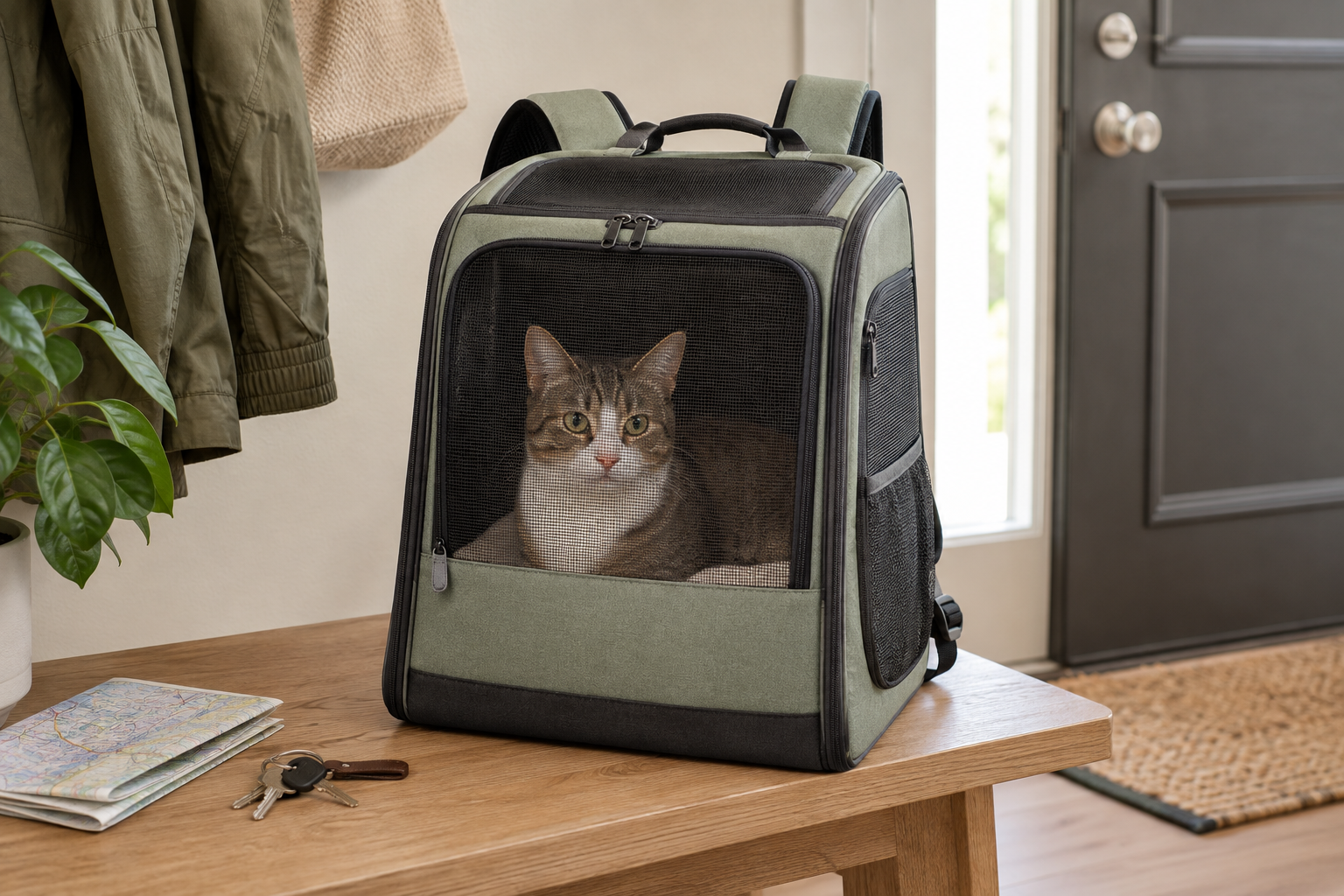
A backpack is a transport and containment tool, not a promise of comfort, escape prevention, airline acceptance, crash protection, or suitability in warm weather. Follow the exact product instructions and current rules for the place or transit service you plan to use.
The five-minute worth-it test
- Pet fit: Does the pet fit the stated usable interior when the liner and curved roof are accounted for?
- Route: Do stairs, doors, or brief transit connections make two free hands meaningfully useful?
- Handling: Can you lift, wear, remove, and set down the carrier steadily at its complete loaded weight?
- Pet response: Can the pet use this shape and motion without marked distress or repeated attempts to damage mesh or closures?
- Maintenance: Will you clean, dry, inspect, and store the backpack according to its directions?
Several confident yes answers support the purchase. Uncertain fit, rare trips, difficult handling, or a pet that does better in a conventional carrier points toward delaying or skipping it.
When a backpack earns its space
The clearest use case is a short, repeat route where you must manage building doors, stairs, tickets, or a second small bag while keeping the occupied carrier stable. Two padded adjustable shoulder straps can distribute the load more evenly than a single shoulder strap, provided the backpack fits the wearer's torso and stays upright as directed.
It may also be useful in a small home when one carrier can handle the routine and store compactly afterward. Folding is only helpful if the walls and base return to their intended structure before each use.
Measure more than the listed weight limit
Use the manufacturer's measuring method and compare the pet with the interior length, width, and height—not just the exterior dimensions. Pockets, padding, curved panels, frames, and liners can reduce usable space. Then add the carrier's empty weight to the pet's weight before deciding whether the load is realistic for you.
Check that the base remains level and supported and that the pet is not forced into an unsuitable posture. If pain, breathing, mobility, recovery, temperature regulation, or pronounced travel distress affects the decision, ask a licensed veterinarian about the transport setup rather than trying to solve it with a product feature.
Ventilation, access, and inspection tradeoffs
- Mesh placement: Check panels while the bag is worn and set down; clothing, walls, or luggage should not block them.
- Openings: Plan to place the backpack on a stable surface in a secure area before opening it.
- Closures: Inspect zipper tracks, clips, seams, mesh, handles, straps, and anchor points before every trip.
- Weather: Mesh alone does not make heat exposure appropriate. Keep trips within conditions suitable for the individual pet.
- Internal hardware: Follow the maker's directions; a tether can create an entanglement or choking risk if used incorrectly or with unsuitable equipment.
Cleaning, storage, and ongoing cost
A removable liner or base cover can simplify ordinary messes, but only if it fits back correctly. Follow the product label for cleaning, dry every part fully, and store the carrier where its structure and mesh will not be crushed or snagged. Replacement liners can add cost, while a heavily damaged zipper, seam, mesh panel, base, or strap attachment may mean retiring the carrier rather than improvising a repair.
Who should skip a carrier backpack?
Skip it when the pet does not fit the measured interior, exceeds the maker's limit, struggles with the upright format or motion, or repeatedly attacks closures. It is also a poor buy when the wearer cannot manage the loaded weight steadily, the route offers no hands-free benefit, ventilation will be obstructed, or a destination requires another carrier type.
A standard hand or shoulder carrier may be simpler for a short car-to-door transfer, frequent set-downs, easier side access, or a pet already comfortable in that format. A hard-sided carrier may make more sense when rigid structure and wipe-down cleaning matter more than wearing it.
Questions to answer before buying
- What are the current interior dimensions and stated weight limit?
- How much does the empty backpack weigh?
- Does the base stay supported when lifted and worn?
- Can you keep all ventilation panels clear throughout the route?
- Can the backpack be opened without creating an escape opportunity?
- Which pieces remove for cleaning, and how must they dry?
- Where will the backpack be stored without deforming it?
The bottom line
A pet carrier backpack is worth it when it fits both bodies, solves a repeat hands-free handling problem, and can be used, cleaned, inspected, and stored as directed. It is not worth buying for appearance alone or as an attempted fix for poor fit or travel distress.
If the category passes that test, use the pet carrier backpack buying guide to compare structured, expandable, and compact varieties. If carry position is still the question, read the backpack-versus-shoulder-carrier comparison. For a broader next step, browse the walking and outing buying-guide hub.