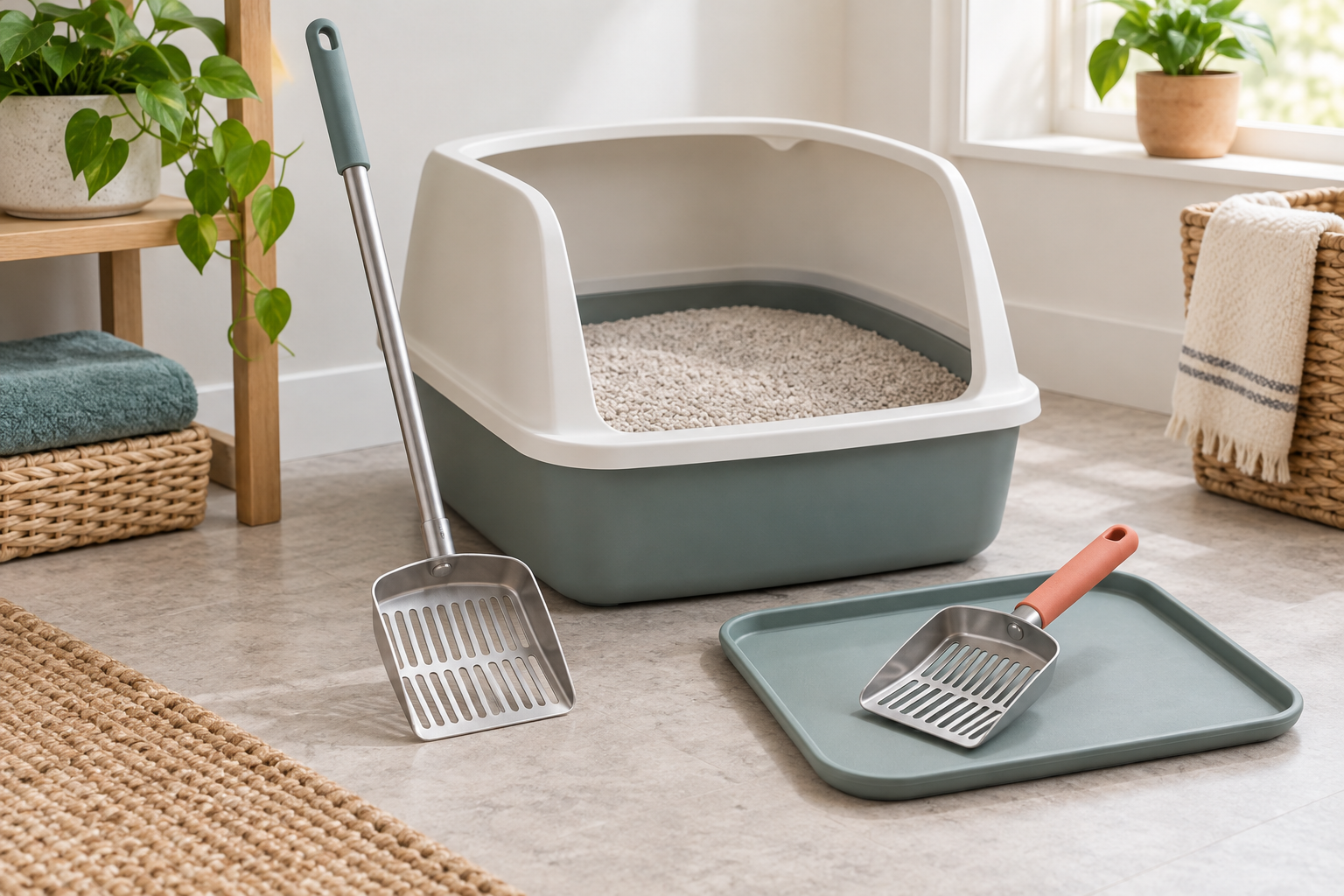
This comparison is about tool geometry, not sanitation promises or health treatment. A different scoop will not solve sudden litter-box avoidance, straining, pain, blood, diarrhea, constipation, or a major change in urine or stool. Contact a veterinarian promptly about those signs.
Quick Comparison
Long-handle scoop: better for extra reach into a large open box, upright wall storage, and owners who can control the longer lever comfortably. Handheld scoop: better for close leverage, covered-box openings, tight corners, small holders, and compact storage. Choose neither yet: when the real mismatch is basket width, slot spacing, edge shape, material, or a litter box that is difficult to access safely.
When a Long-Handle Scoop Fits Better
A long handle suits a large, open litter box when the basket can move from front to back without striking a hood, wall, or nearby shelf. Extra reach may make the far side easier to access, but the useful measurement is total tool length plus turning room—not a vague “no-bend” label.
Look for a rigid handle-to-basket joint, a grip that does not rotate, and a basket sized for the box corners. Think about the loaded tool as a lever: a large clump held far from your hand may feel less controlled than the empty scoop suggests. A hanging loop or dedicated tall holder also needs secure clearance outside the cat's entry path.
When a Handheld Scoop Fits Better
A handheld scoop keeps your grip close to the working edge. That can make it easier to slide beneath a clump, turn in a compact box, and work through a front opening. It also fits more scoop holders and shallow cleaning cabinets.
Choose this format when the box has a hood, high sides with a small entry, tight corners, or limited space around it. The tradeoff is reach: you may need to kneel, bend, or bring your hand farther into the box area. If that movement is uncomfortable or unsafe for you, change the setup rather than forcing the motion.
Tradeoffs That Matter
- Box clearance: measure the opening, interior width, wall height, hood clearance, and space above and beside the box. A long shaft can collide before the basket reaches a corner.
- Control and leverage: a short handle keeps your hand near the load. A long handle extends reach but can magnify wobble at a weak joint.
- Basket and slots: handle format does not determine sifting performance. Match basket width, depth, front edge, and slot spacing to the box and litter granules.
- Loaded weight: compare the complete scoop with a realistic load, not only the listed empty weight. Larger metal baskets and longer shafts can feel top-heavy.
- Storage: long tools usually need a tall holder or secure wall hook. Handheld tools fit compact holders but still need a washable, pet-inaccessible location.
- Cleaning: inspect seams, rivets, telescoping sections, grips, and hollow joints. Simpler construction generally leaves fewer crevices to rinse and dry.
- Material: metal can be rigid but heavy and may mark a liner; plastic is lighter but can flex, crack, or develop rough damage. Follow box-liner and tool-maker directions.
Setup and Maintenance
Measure the box opening and the longest unobstructed working path. Mock up the advertised total scoop length with a broom handle or folded measuring tape, then check whether you can reach each corner without hitting a wall or blocking the cat's route. Measure the intended holder or hook as well.
Store the scoop outside the box entrance, away from food, water, children's items, and food-preparation tools. Remove loose litter, wash the tool only as its maker directs, reach every joint and slot, and let it dry fully before storage. Clean its tray or holder on the same routine. Replace a scoop with a loose joint, crack, corrosion, sharp burr, warped edge, or inaccessible damaged surface.
Who Should Skip Each Option?
Skip a long-handle scoop when a hood, narrow opening, wall, or shelf prevents a natural working angle; when loaded leverage feels unstable; or when there is no secure tall storage spot. Skip a handheld scoop when reaching the far side of the measured box is uncomfortable and the box cannot be repositioned for safer access.
Skip both purchase paths for now if the present scoop already sifts well and stores cleanly. Also pause when difficulty cleaning the box comes from its placement, damaged surfaces, unsuitable litter depth, or a sudden change in the cat's toileting. A veterinarian—not a new tool—is the next step for concerning physical or behavior changes.
Next Steps and Related Guides
Start with the litter scoop buying guide if you still need to choose slot spacing, basket depth, edge shape, or metal versus plastic. Then decide whether a freestanding holder or wall hook fits the chosen handle and available floor space.
For the wider litter area, compare clumping and non-clumping litter by cleanup routine, or check whether a litter mat is worth adding for tracked granules. Browse the cleanup and odor-control hub for the full product path.
Bottom Line
Pick a long-handle scoop when verified reach and an open working angle solve the real problem. Pick a handheld scoop when close control, corner access, and compact storage matter more. The better tool is the one whose basket fits the box, whose slots fit the litter, and whose full loaded length you can use, clean, dry, and store comfortably.