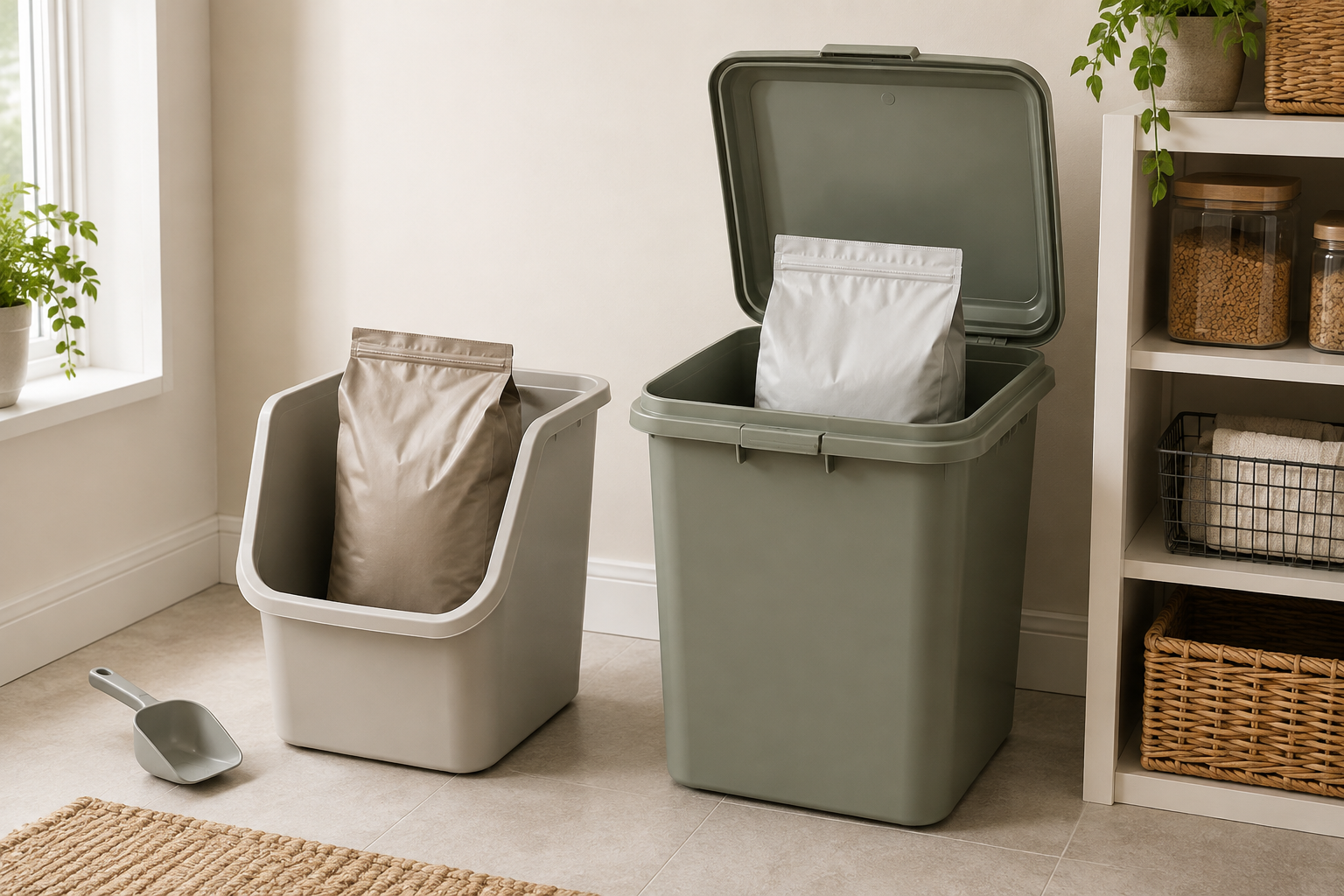
This comparison is about access and home organization. It does not promise freshness, pest prevention, food safety, or a longer storage life. Follow the pet-food manufacturer's current storage directions, keep identifying package details with the food, and stop using food that looks or smells unusual or comes from damaged packaging.
Quick Comparison
Choose an open bin when the bin will stay inside a closed, dry, pet-inaccessible cabinet or pantry and you want to lift the original bag in and out without managing a lid.
Choose a lidded bin when a closure meaningfully improves your storage routine, the lid can open completely, and every pet and child still remains unable to access or tip the setup.
Skip both when the original bag already stands securely in an appropriate location or when either bin would crowd a walkway, be difficult to clean, or make the full bag harder to lift.
Open Bin: Simple Access, More Placement Limits
An open bin has no hinge, gasket, or removable lid to operate. That can help beneath a shelf where vertical clearance is tight, but only if there is enough room for your hand and scoop. The missing closure also makes location especially important.
Open-bin fit
- A cabinet, closet, or pantry door provides the outer access control.
- The whole closed original bag fits below the bin edge without folding it awkwardly.
- You want to see the bag label and remove the bag easily at changeover.
- The bin can be carried, wiped, and fully dried without complex lid parts.
Open-bin tradeoffs
An open top does not restrict curious pets, children, moisture, or household debris. A tall rim may still interfere with scooping, and an angled opening may reduce usable bag space. Do not treat placement on a high shelf as sufficient if the loaded bin is difficult to lift safely.
Lidded Bin: Defined Closure, Extra Clearance
A lid can keep the stored bag visually contained and may help organize a shared pantry. It also introduces a hinge or loose part, a latch, more cleaning edges, and a specific opening path.
Lidded-bin fit
- The lid opens fully without striking a shelf, wall, appliance, or cabinet door.
- The original bag fits inside without preventing the lid from closing as designed.
- You can operate the lid and reach the scoop without bending or twisting awkwardly.
- The bin can slide or roll into a clear working position if the storage bay is low.
Lidded-bin tradeoffs
A latch is not a guarantee that a bin is pet-proof or child-resistant. Hinges, rims, seals, and wheel wells take extra cleaning, while a removable lid needs a clean place to rest. A broad lid can make an otherwise compact bin unusable beneath fixed shelving.
Measure the Bag, Opening, and Working Path
- Original bag: Measure its widest and deepest points when full, plus its closed height.
- Usable interior: Check the narrowest inside points, not only the advertised external volume.
- Hand clearance: Leave room to open the bag, hold the scoop level, and read the label.
- Lid swing: Measure from the hinge through the lid's full path, including knobs and handles.
- Loaded movement: Decide whether the bin stays put, slides forward, rolls, or must be lifted for every use.
- Household access: Account for pets, children, nearby heat or moisture, and anything that could fall into an open bin.
Cleaning and Food Changeover
Keep crumbs out of the space between the bag and bin. Follow the bin maker's care directions, clean handles and contact points, and let every washed surface dry completely before replacing the packaged food. Inspect hinges, latches, wheels, and sharp or cracked edges during routine cleaning.
Do not top up old loose food with a new bag. Retaining the original bag keeps the label, lot code, date, ingredients, and feeding directions available. If a bin is marketed for direct food contact, verify that current claim and the pet-food maker's directions rather than assuming all storage plastics are equivalent.
Who Should Skip This Purchase?
Skip a dedicated bin if it duplicates a secure cabinet, forces you to lift a heavy full bag twice, or cannot be opened and cleaned comfortably. An ordinary sturdy outer tote may be enough when its dimensions and location fit the packaged bag.
Storage equipment is not an answer to appetite, weight, vomiting, diarrhea, sudden thirst, or other health changes. Contact a licensed veterinarian about those concerns.
Bottom Line
An open bin is the lower-friction format for a protected pantry with reliable outer access control. A lidded bin earns its extra parts when the closure and structured footprint genuinely improve the routine and there is enough room to operate it. In either case, measure the full original bag, retain its information, and choose the setup you can access, clean, and keep out of reach.
Continue with the new-pet essentials guide or plan a more complete low-mess feeding station.