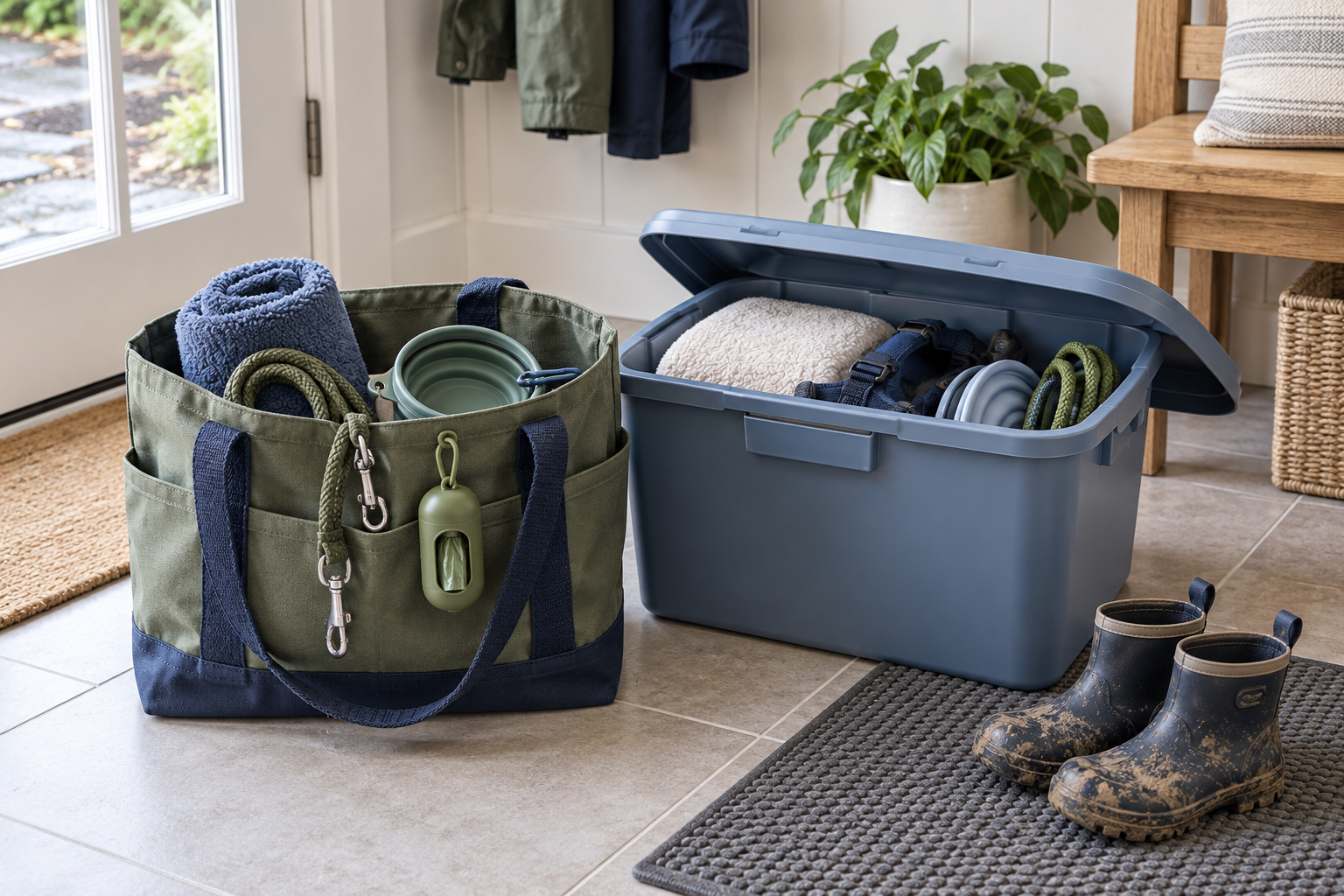
Quick Comparison
An open washable tote makes contents visible and quick to remove. It suits a mobile kit or a deliberate drop zone before each item is cleaned and dried. The tradeoffs are exposed contents, less structured stacking, and possible pockets or seams that take extra work to clean.
A rigid lidded bin creates a defined closed footprint for clean, dry backups and seasonal walking gear. The tradeoffs are lid clearance, less immediate visibility, corners that collect debris, and the temptation to close the lid before damp items have dried.
Do not choose by an unsupported “odor proof,” “waterproof,” or “antimicrobial” claim. Choose by measured fit, access, construction, stated care, and a realistic unpacking routine.
Map the Wet-Walk Workflow First
Trace the route from the door or vehicle to the cleaning and drying area. Muddy boots, damp paw towels, wet leashes, and collapsible bowls need their own cleanup and complete drying steps before long-term storage. A washable mat, boot tray, or utility bucket may be the better first landing zone.
- Arrival: decide where dirty items can sit without blocking a doorway or creating pet access.
- Cleaning: follow each item's maker directions and keep cleaners inaccessible.
- Drying: spread or hang washable gear as directed rather than leaving it folded inside either container.
- Reset: return only clean, fully dry items to the tote or bin.
When an Open Tote Fits Better
An open tote fits when the kit travels regularly and you want to see what needs to be unpacked. Soft construction can be easier to carry or store when empty, but confirm the loaded handle guidance, base support, pocket dimensions, and whether every seam and lining can be cleaned and dried.
Place the tote where a dog cannot pull out waste-bag rolls, clips, bowls, towels, or other small gear. Skip open storage for anything hazardous, sharp, medicated, edible, or otherwise unsuitable for unsupervised access.
When a Lidded Bin Fits Better
A lidded bin fits clean, dry gear that stays in one place and benefits from owner-managed access. Measure the bin with the lid fully open, including shelf or bench clearance. Check whether the interior bottom and corners are reachable for cleaning and whether a loaded bin can be moved without exceeding maker guidance.
A loose or simple lid is not a security device. Keep the entire bin in an inaccessible location when its contents require controlled access. Follow the maker's stack and latch directions, and do not sit or stand on a storage bin.
Measure the Load, Storage Spot, and Cleaning Work
Lay out one real post-walk kit. Measure the longest leash, tallest bottle-free accessory, widest folded towel, and any rigid bowl. Compare those measurements with usable interior dimensions rather than exterior capacity alone. Then measure the route, shelf, door swing, and lid-opening space.
Favor simple interiors, removable inserts only when they help, and care directions you can actually follow. Retire fabric with torn handles, open seams, or residue that cannot be removed. Retire rigid bins with sharp edges, spreading cracks, damaged handles, or a lid that no longer operates as intended.
Who Should Skip Each Format?
Skip an open tote when the gear must remain inaccessible, the loaded base sags, narrow items fall from pockets, or the fabric care does not suit routine mud. Skip a lidded bin when you lack lid clearance, tend to seal damp items, cannot reach its corners, or need the kit to travel frequently.
Skip buying either one if an existing washable household tote, bucket, or bin already fits the dry load and can be stored appropriately. If the recurring problem is the doorway surface rather than the container, build a pet doorway cleanup station. For vehicle floors, compare trunk liners for muddy dog gear.
Bottom Line
Choose an open washable tote for a visible, portable kit that you reliably empty after wet walks. Choose a lidded bin for clean, completely dry gear stored in a measured fixed location. Keep the cleaning and drying zone separate, control pet access, and repurpose a suitable container when it already solves the problem.