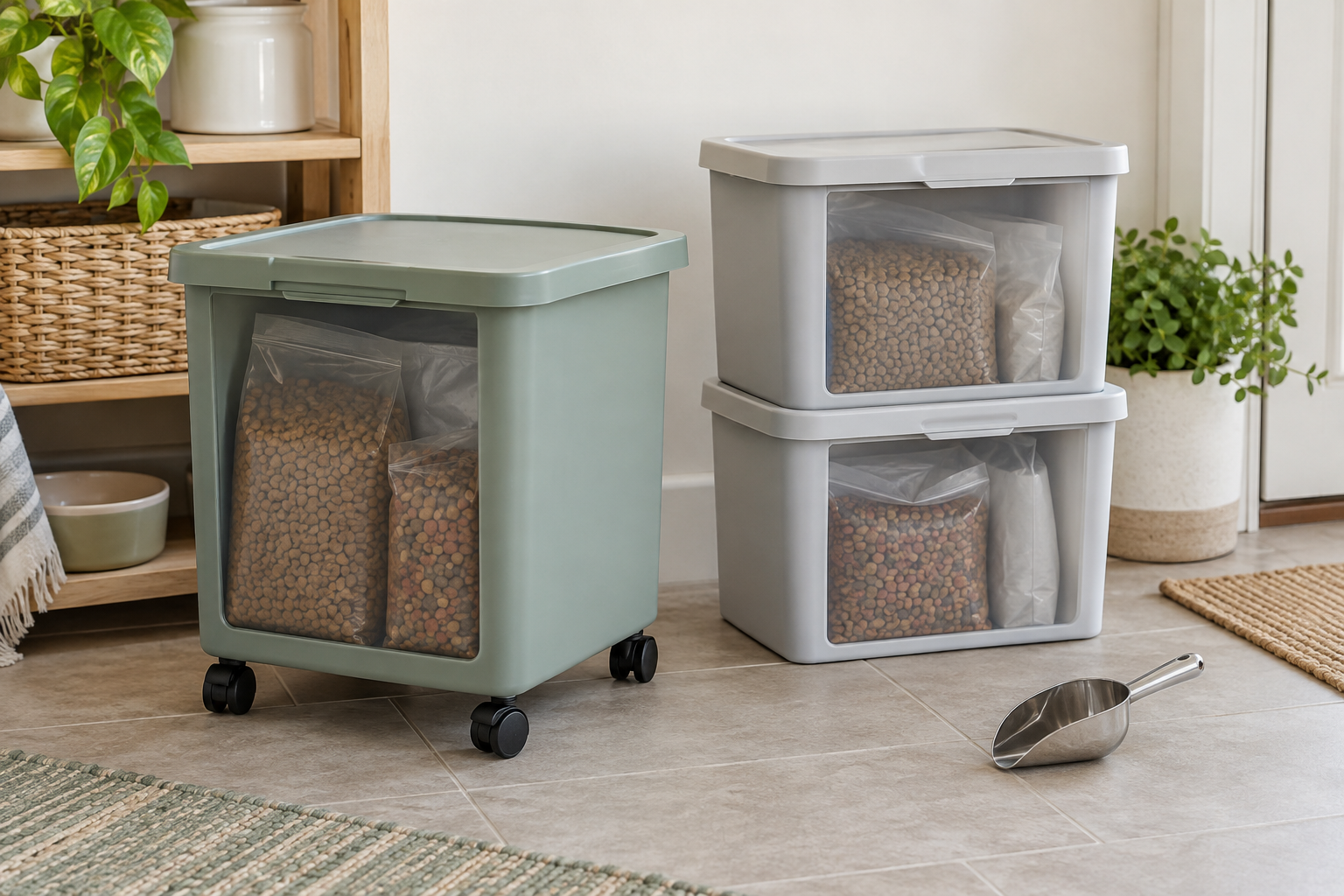
Quick Comparison
Wheeled containers keep one container at floor level and can move it for access or cleaning. The tradeoffs are caster height, turning room, thresholds, rolling stability, and a larger continuous footprint.
Stackable containers divide food into separate units and use height instead of extra floor width. The tradeoffs are lifting, stack limits, access to the lower unit, overhead clearance, and the need to label each food clearly.
Neither layout guarantees freshness, pest control, sanitation, or a longer storage life. Those outcomes depend on the current food packaging, container construction, handling, environment, and manufacturer directions.
Measure the Bag, Route, and Working Clearance
Measure the original bag at its widest and tallest points, then compare it with the container's usable interior rather than its advertised outside capacity. If keeping the food in its bag makes the package bunch, tear, or block the lid, choose a better-fitting format rather than forcing it.
- For wheels: measure the route, doorway, thresholds, turns, baseboard clearance, and space needed to open the lid.
- For a stack: measure total height, ceiling or shelf clearance, access openings, and the footprint of every unit in the approved arrangement.
- For either: keep the label, lot information, date information, and feeding directions available.
Who a Wheeled Container Fits
A wheeled bin is the simpler choice for one bulky bag stored on a smooth, level pantry or utility-room floor. It can make cleaning behind the bin easier and reduce the need to carry the whole container, but loading the bag and crossing a threshold may still require lifting.
Look at wheel placement and ground clearance, not just the presence of casters. Small wheels may struggle with grout lines, mats, uneven transitions, or debris. Use locks as directed, keep the parked bin away from stairs and traffic routes, and never assume wheels make an overloaded container easy to control.
Who Stackable Containers Fit
A stackable format fits households separating two foods, bag sizes, or feeding routines in a narrow footprint. Each container needs its own clear label, and the stated stack arrangement should remain stable on a level surface where pets and children cannot pull or climb on it.
Check whether the lower unit opens while loaded and stacked. A top-opening design may require unstacking every time, while a front-access design still needs enough room for its door and bag. Do not place a heavier container above a lighter one unless the maker specifically permits that loaded arrangement.
Setup, Cleaning, and Maintenance
Follow both the container maker's care instructions and the pet-food maker's storage directions. Empty and clean the container as directed, then let every surface dry completely before replacing a bag. Do not mix remnants of different foods simply to avoid cleaning or save space.
Inspect wheels, axles, handles, lids, hinges, latches, stacking ledges, and seams. Stop using a container that rolls unpredictably, rocks in its approved stack, has sharp or cracked parts, cannot be cleaned, or no longer closes as designed. Keep scoops clean, dry, and stored according to applicable directions rather than buried in food.
Who Should Skip Each Format?
Skip wheels when the route has stairs, thick rugs, rough transitions, a slope, or too little turning space; when the parked bin would sit in a walkway; or when you still cannot load it without uncomfortable lifting. A fixed small container may fit better.
Skip stacking when you cannot comfortably reach the upper unit, must repeatedly lift a loaded container, cannot open the lower unit in place, lack a maker-approved stack configuration, or have a pet or child who can climb or pull at it.
Skip buying either format if the original bag already fits securely in a dry, inaccessible location and the current routine is easy to label, clean around, and manage. If lifting or reach is painful or unsafe, seek appropriate professional guidance about the home setup rather than relying on a storage product to solve it.
Bottom Line
Choose wheels for one larger bag, a clear level route, and floor-level access. Choose a stack for separated foods and a narrow footprint only when the loaded configuration, access height, and lifting routine work safely. In both cases, original-package fit, labels, cleaning, dry storage, and maker directions matter more than the layout name.
For the broader new-pet setup, see starter pet supplies that actually help. If access style is still undecided, compare open and lidded pet-food storage bins; for a floor-standing choice, also check washable mats under pet-food storage bins.