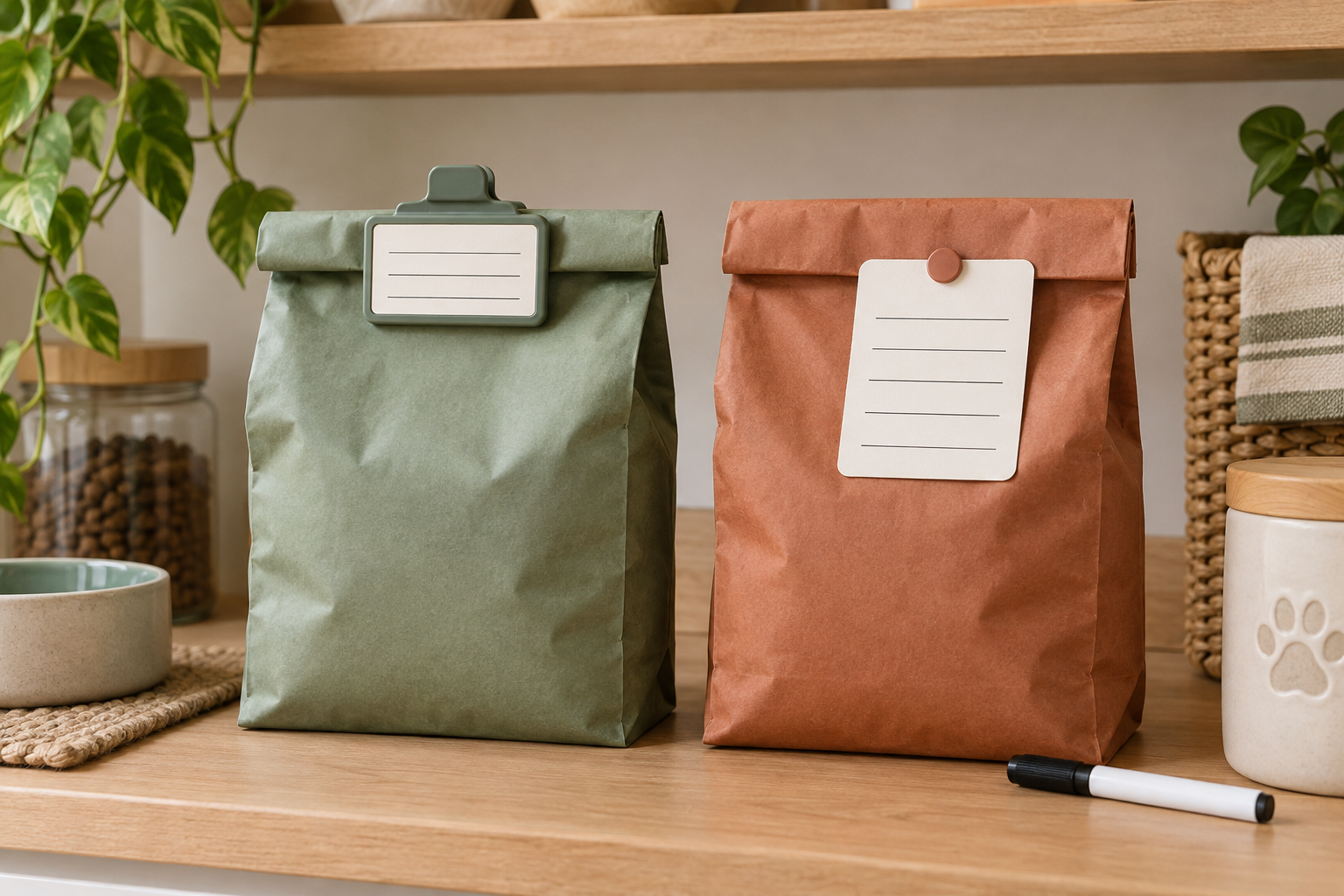
This guide covers optional organization labels for ordinary packaged dry pet food and treats. It does not provide food-storage-life, portion, nutrition, or diet advice. Follow the food maker's packaging and storage directions, and ask a veterinarian about feeding amounts, diet changes, appetite changes, or other health concerns. If you are not sure another label is necessary, start with the reusable pet food label worth-it test.
Quick Comparison
A clip-on holder can move from one compatible bag to the next and avoids adhesive contact with the package. It also adds thickness near the fold, can snag during scooping or shelf handling, and may include small detachable parts. The clip opening and pressure must suit the actual package without damaging it or weakening its closure.
A removable write-on label lies flatter and usually offers more writing space. Its usefulness depends on the package surface, permitted marker, removal method, and whether it leaves residue or loses adhesion through repeated handling. “Removable” or “reusable” should be treated as a maker-specific instruction, not a universal guarantee.
Neither format seals a bag, preserves food, verifies a date, prevents mix-ups by itself, or replaces the original packaging information. The label is an organization aid only.
Decide What the Extra Label Needs to Show
Use the smallest amount of unambiguous information that helps the household distinguish the bag. A pet name or ordinary category note may be enough. Copying feeding directions, expiration wording, lot codes, or medical instructions onto an informal label creates a second record that can become incomplete or outdated.
- Keep originals visible: do not cover the product identity, ingredients, feeding guide, lot information, dates, storage directions, warnings, or maker contact details.
- Separate similar bags: choose a color or short written note only if every household member understands it.
- Avoid unsupported dates: do not invent “use by,” freshness, or safe-storage timelines.
- Keep notes current: erase or discard an old household label before it moves to a different product.
- Preserve closure access: the extra label should not obstruct a zipper, fold, clip, valve, seam, or pouring path.
When a Clip-On Label Fits Better
A clip-on holder is a practical first comparison when similar bags rotate through the same pantry spot and a small tag needs to move with the current package. Measure the folded edge thickness and the clear space around the closure. Compare those measurements with the stated clip opening and label size rather than judging from a product photo.
Look for smooth contact surfaces, a tag that remains readable at the normal shelf angle, and a writing insert that can be removed or cleaned as directed. Check the clip, hinge, insert, and cap for cracks or loose pieces. Store spare components and markers where pets cannot chew or swallow them.
Skip a clip that pinches a zipper, punctures or sharply creases the package, prevents a full fold, covers printed information, or projects into a narrow shelf route. A large clamp may solve a visibility problem while making daily access more awkward.
When a Removable Write-On Label Fits Better
A write-on format can fit when the package has a clean compatible surface and the household needs larger, front-facing writing. Check whether the label is intended for paper, coated film, plastic, or a separate smooth bin; one adhesive may behave differently across those surfaces. Follow the maker's application and removal directions.
Confirm the stated marker or pen type and the recommended erasing method. Test only where the label maker permits, away from required packaging information. Remove residue using a method compatible with the package; do not use cleaners near food packaging unless both the label and food-package directions allow it.
Adhesive labels are less useful on dusty, oily, heavily textured, sharply folded, or frequently flexed surfaces. If the label curls, slides, transfers color, or stops adhering, remove it before a pet can reach the loose piece.
Plan the Cleaning, Reuse, and Bag-Change Routine
When a bag empties, compare the extra label with the original package before moving or rewriting anything. Erase the household note completely or discard it as directed. Clean a reusable holder using its current care instructions, then dry every part before attaching it to a new bag.
Do not transfer a label automatically when the replacement product, formula, size, or feeding directions differ. Keep the new food in its own labeled package and re-check the maker's directions. If you place the closed original bag inside a separate container, use the original-bag versus container comparison to plan that storage decision.
Who Should Skip Each Format?
Skip a clip-on holder when the package edge is too thick, the clip interferes with closure, small parts would be accessible to a pet, or the tag protrudes into a tight shelf. Skip a write-on label when the package surface is not listed as compatible, removal directions are unclear, residue would cover important printing, or repeated flexing makes the label detach.
Skip both when only one clearly identified bag is open, the original label is easy to read, or a simple shelf position already prevents mix-ups. Another accessory is not useful if it adds a second information source without making the routine clearer.
Related Feeding-Station Decisions
For the measuring tool, compare pet food scoops and measuring cups. For a wider setup checklist, use the new-pet essentials guide. Keep household labels secondary to the current package and any feeding plan provided by your veterinarian.
Bottom Line
Pick a clip-on holder when a small reusable tag should move between compatible bags without adhesive contact. Pick a removable write-on label when a broad, flat writing area suits the package surface and the stated removal routine. Preserve the original information, measure the attachment area, keep loose parts away from pets, and skip the purchase when the package is already clear.