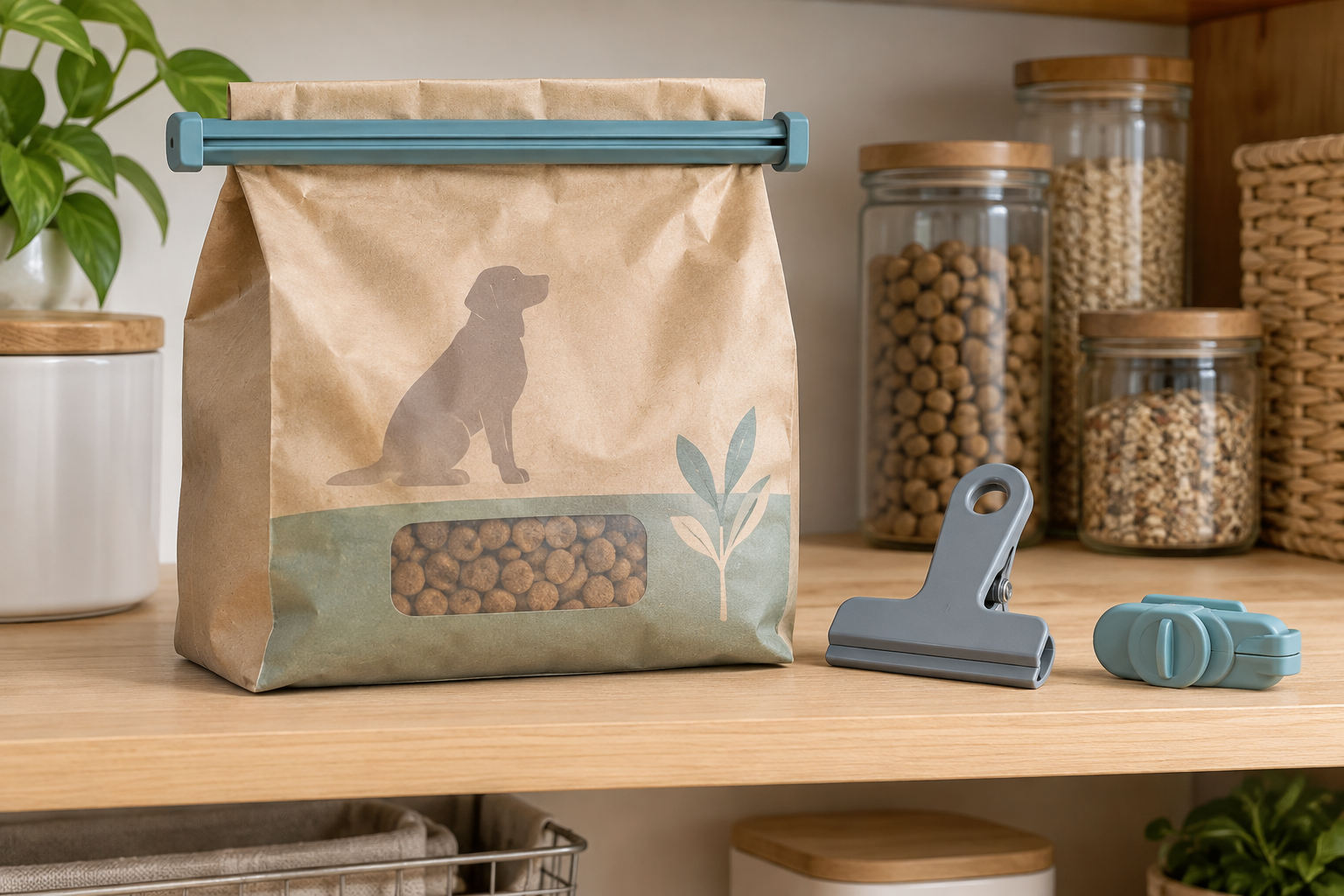
This guide compares closure tools for ordinary dry pet-food packaging. Follow the food maker's storage instructions, keep the original label and lot information, and discard food or packaging as directed if either is damaged, contaminated, damp, or otherwise questionable. Ask a veterinarian about feeding amounts, diet changes, appetite changes, or health concerns.
Choose the fold before the clip
Close the package using its own closure if one is provided. For a bag that needs an extra clip, press out only the excess air the manufacturer directs you to remove, flatten the top without stressing seams, and fold or roll it into a shape the clip can hold without tearing the package. A clean, even fold gives a wide sliding clip more surface to grip. A narrow rolled corner may suit a spring clamp better.
Do not punch holes, trim the package, cover required information, or force a rigid clip over a zipper, valve, thick side gusset, or uneven seam. If the package is too stiff or wide for the clip, choose a larger compatible format or place the entire closed original bag inside a measured lidded bin.
Quick comparison framework
- Wide sliding seal clip: strongest first comparison for a broad, evenly folded top and a clip long enough to span it.
- Heavy-duty spring clip: fastest to remove and replace on a compact fold, but it grips only a limited area.
- Twist-lock or channel clip: compact for gathered openings that match its specified channel, but awkward on thick or wide folds.
- Built-in zipper or closure: simplest option when it still works and the package instructions say to use it.
- Original bag inside a lidded container: useful when the bag slumps or needs structure; the container still needs measured fit and routine cleaning.
Selection criteria that matter
- Usable clip length: measure the folded top, not the bag's printed face. Leave room around thick seams and gussets.
- Opening capacity: compare the folded package thickness with any stated channel, jaw, or roll capacity.
- Closure action: sliding, clamping, and twisting require different hand motions. Choose one you can operate consistently without forcing it.
- Contact surfaces: smooth, broad gripping areas are less likely to create one sharp pressure point than narrow or damaged edges.
- Materials and construction: inspect hinges, springs, rods, caps, and locking parts. Retire a clip that cracks, rusts, bends, or sheds pieces.
- Cleaning: follow current care directions and dry hinges, channels, and hollow parts fully before the clip returns to storage.
- Label access: keep the product name, lot code, date, feeding instructions, ingredients, and manufacturer contact details readable.
- Pet access: store the closed bag and spare clips where pets cannot chew, swallow, or play with them.
Match the format to the daily routine
A sliding clip makes the most sense when the same person opens a wide bag once or twice a day and has enough counter or shelf clearance to remove a long rod. A spring clamp is quicker on a smaller fold and easier to hang nearby, though a very strong spring may be uncomfortable for some hands. A compact channel or twist-lock format can reduce drawer clutter, but only if it accepts the actual gathered bag without crushing a seam.
If several household members feed the pet, choose the closure everyone can use correctly. Keep a dedicated, clearly stored measuring tool nearby rather than asking the clip to double as portion guidance. The pet food scoop and measuring-cup guide covers that separate decision. If similar bags are difficult to tell apart, compare clip-on and write-on label formats without covering the original package information.
Cleaning and storage
Brush away dry crumbs before washing. Use only the cleaning method stated for the clip, open moving parts where directed, and let every surface dry. Do not return a damp clip to a paper or multilayer bag. Wipe the outside of the food package as appropriate and check the shelf for spills, dampness, pests, or damaged packaging during routine resets.
Keep spare clips together in a dry drawer or lidded caddy rather than loose near pet bowls. Avoid using the pet-food clip on household trash, cleaning-product bags, or other materials that could transfer residue.
Who should skip a dedicated bag clip
Skip one when the bag's built-in closure works, the food maker directs a different storage method, or a clean clip you already own fits and operates reliably. Also skip any clip that covers package information, cannot close without distorting seams, has small detachable pieces accessible to a pet, or is difficult for the household to use every day.
If the real problem is that the bag tips, blocks a walkway, or is hard to lift, a clip will not fix the storage setup. Compare pet food storage containers for small kitchens and keep the original package with the food whenever practical.
The bottom line
Start with a wide sliding clip for a broad, straight fold; choose a spring clamp for quick access to a smaller folded opening or a compact twist-lock format only when its channel fits. Measure first, preserve the package information, follow the food maker's directions, keep clips away from pets, and skip the purchase when the original closure already does the job.