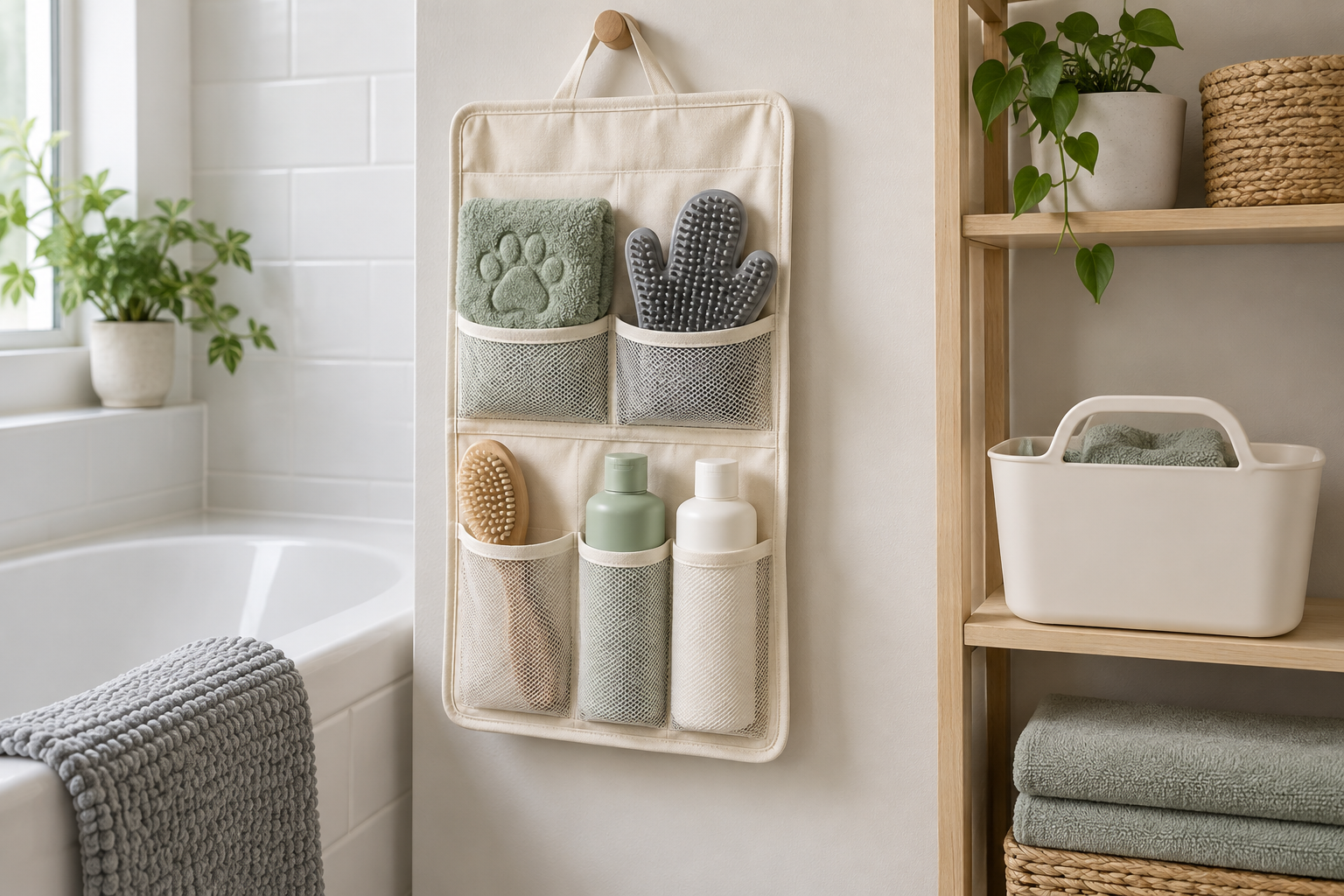
This guide covers optional storage for ordinary non-medicated supplies such as clean towels, a rinse cup, a simple brush, and pet shampoo used according to its label. It does not cover bathing technique, restraint, skin conditions, medicated products, or hazardous cleaners. Ask a veterinarian about persistent itching, sores, pain, unusual hair loss, or whether bathing is appropriate for a pet with a health concern.
When a Hanging Organizer Earns Its Space
The purchase makes sense when baths happen often enough that the same small kit repeatedly occupies a counter or gets carried item by item. The bathroom needs a compatible mounting point that the product maker identifies, enough loaded clearance, and a place beyond unsupervised pet access.
Vertical storage is most useful when visibility matters and each pocket has one simple job. It is less useful when supplies must leave a shared bathroom, wet items need a separate drying area, or the organizer would become a catchall for grooming tools that belong in secure storage.
Run a Bath-Setup Audit Before Buying
- Frequency: note how often the same supply kit is actually used and whether counter clutter recurs.
- Inventory: measure only the ordinary items that belong at the bath station; keep medication, blades, concentrated cleaners, pest products, cords, and small hazards elsewhere.
- Mounting: identify the exact hook, door, rail, or other support and compare it with the maker's permitted methods.
- Clearance: measure the loaded organizer against doors, curtains, cabinets, faucets, walking space, and the pet's movement.
- Access: check that bottles lift out easily while the contents remain beyond your pet's reach.
- Aftercare: decide where wet towels, brushes, cups, and the organizer itself can dry as directed.
Measure pocket openings and usable depth rather than relying on the overall organizer dimensions. A tall bottle that fits on paper may tip, strain a shallow pocket, or be difficult to remove under a shelf. Follow the stated load guidance; appearance is not evidence of capacity.
Cost, Setup, and Maintenance Tradeoffs
A hanging organizer charges for vertical pockets, mounting hardware or loops, and a fixed visual station. It also adds setup checks, seam and attachment inspections, pocket cleaning, and drying time. Fabric and mesh may flex around bottles; solid pockets may be easier to wipe but can hide moisture or small residue. Check the actual care directions rather than assuming a material is washable.
Over-door models avoid some wall mounting, but the hook thickness and organizer load can affect door clearance. Wall-hung formats need a suitable surface, the specified hardware, and permission in a rented home. Neither format should be mounted by improvising with an unsupported fixture.
After a bath, remove wet textiles and tools, clean items according to their instructions, open pockets, and let every surface dry fully before repacking. An organizer can hold supplies; it does not dry them automatically or make a damp setup hygienic.
Try a Cheaper Alternative First
Use a suitable handled basket you already own for two or three bath routines. If carrying the kit to and from secure storage feels easy, a fixed hanging product may add little. A dry existing shelf or cabinet also wins when the routine happens in one room and the items already fit.
If portability versus visibility remains the real decision, compare the handled basket and hanging organizer formats. For a larger grooming inventory, use the small-bathroom grooming organizer guide without treating open bath storage as appropriate for every tool.
Red Flags Before You Buy
- No clear pocket dimensions, mounting method, stated load guidance, or care directions.
- A hanger that does not match the intended door, rail, hook, or wall support.
- Loaded pockets that block a door, cabinet, shower curtain, faucet, or walking path.
- Loose seams, stretched loops, cracked hooks, sharp edges, or detachable parts within pet reach.
- A proposed location exposed to direct spray when the maker does not permit it.
- A plan that leaves medicines, blades, concentrated cleaners, pest products, or other unsuitable items in open storage.
Stop using an organizer if its support shifts, attachments loosen, pockets tear, hardware develops sharp damage, or contents begin falling out. Move supplies immediately if a pet can reach, chew, pull, or climb toward them.
Who Should Skip a Hanging Pet Bath Organizer?
Skip it when baths are occasional, an existing basket or dry shelf already works, the kit must travel, or there is no compatible permitted mounting point. It is also poor value when door clearance is tight, the proposed location stays damp, or the organizer would be accessible to a curious pet.
Delay the purchase if you have not measured the actual items and loaded clearance. Choose a portable basket when the bathroom is shared or supplies belong in a closed cabinet. Escalate health or handling concerns to a veterinarian or qualified groomer rather than using storage equipment as a solution.
Bottom Line
A hanging pet bath organizer is worth buying when a small fixed kit creates recurring clutter, the measured pockets and permitted support fit, wet items have a separate drying routine, and ordinary supplies remain inaccessible to pets. Repurpose a handled basket first, and skip the organizer when existing secure storage already solves the problem.
For the next product-format decision, compare mesh and solid pet bath caddies by drainage, small-item retention, cleaning, and drying.