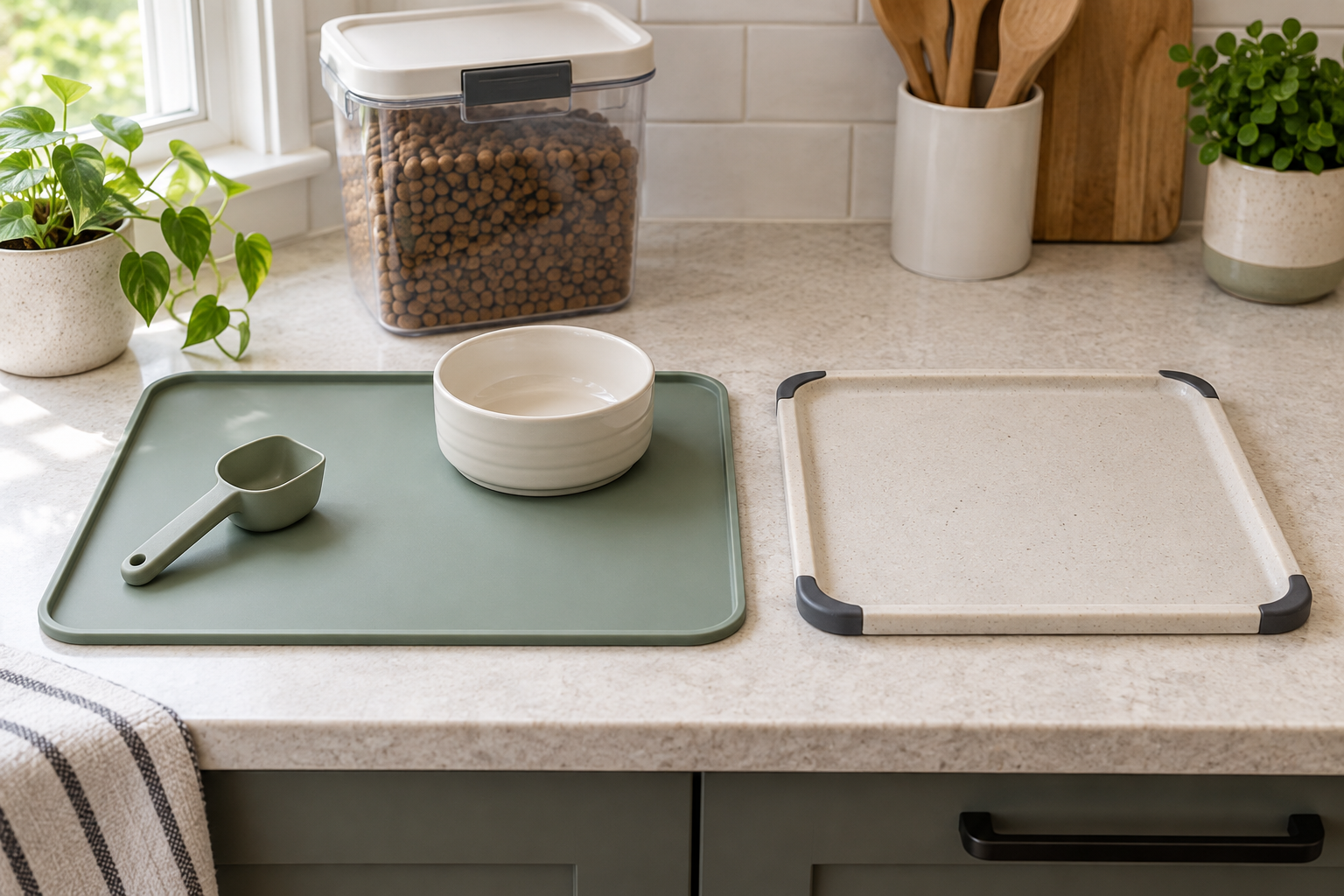
This guide covers an optional washable work surface for ordinary pet-food preparation. It does not provide portion, diet, food-storage, or food-safety advice. Follow the food maker's handling and storage directions, keep original labels available, and ask a veterinarian about feeding amounts, diet changes, appetite changes, or other health concerns.
When a Dedicated Prep Mat Is Worth It
The purchase can make sense when food is prepared on the same counter every day, the mess stays within a predictable footprint, and lifting one fitted surface genuinely makes cleanup or resetting the area easier. It should fit the scoop, bowl, lid, or can cover used in the routine without pushing items close to the counter edge.
A mat may also earn its place when you want a visually distinct, portable work zone that moves directly to the sink or laundry. That convenience only counts if the material's current care instructions match your actual washing and drying capacity.
Run a One-Week Routine Audit
- Frequency: count how often you scoop, portion, open, mix, or reseal pet food on the counter.
- Mess pattern: note whether the real problem is dry crumbs, modest drips, a damp utensil, or simply too many loose items.
- Usable footprint: measure the scoop, bowl, container, lid, and working hand space together—not just the empty counter.
- Counter fit: leave controls, seams, appliance vents, sink edges, and the counter edge clear.
- Cleanup path: decide whether the whole mat fits flat in the sink, dishwasher if permitted, or laundry load, then identify where it dries completely.
- Storage: check whether a clean dry mat can stay flat, roll, or fold according to its design without becoming another loose counter item.
For the test, use a suitable washable tray or board you already own. If it contains the normal mess and is easy to clean, dry, and store, a dedicated mat is unlikely to add much. If it slides, is too small, or ties up something needed for another routine, record the exact failure before shopping.
Cost, Setup, and Maintenance Tradeoffs
You are paying for a repeatable workspace and easier lifting, not a health benefit. Include the time and space required to wash, dry, and store the mat. A low-cost mat is still poor value if its usable area is smaller than advertised overall dimensions suggest or if its edges conflict with tools.
Low-edge silicone formats can handle modest drips and wipe directly, but they can be bulky in a small sink and may need flat or rolled storage. Fabric formats can fold into laundry, but they add laundering and complete-drying time. Compare only current material, surface-compatibility, temperature, and care claims from the maker; do not assume every mat is dishwasher-safe, machine-washable, stain-proof, or suitable for every countertop.
Clear crumbs promptly, wash the mat as directed after the routine, and let it dry completely before storage. Inspect it for cracks, peeling layers, lifted edges, damaged backing, trapped residue, or persistent deformation, and replace or stop using it when it can no longer sit stable or be cleaned as intended.
Use a Tray, Board, or Direct Cleanup
A washable tray or dedicated board can provide a defined surface without another purchase, especially for a small dry-food routine. It should be stable, intact, large enough for the actual tools, and cleaned according to its intended use. Direct counter cleanup is simpler when the approved surface is uncluttered and the mess is small.
If your audit confirms a dedicated mat would help, use the small-counter prep-mat guide to compare clearly defined formats, then the silicone versus fabric comparison for material tradeoffs. The new-pet essentials pillar helps keep the broader feeding setup focused on useful routine pieces.
Red Flags Before You Buy
- No exact overall and usable dimensions, material description, or care and drying directions.
- Claims that a mat sanitizes food, prevents illness, controls portions, or replaces appropriate handling and cleaning.
- A mat that would cover a counter seam, appliance vent, control, sink lip, or working edge.
- A surface that slides, curls, lifts, sheds, cracks, or cannot lie flat under the planned tools.
- A wash method that does not fit your sink, appliance permissions, laundry cadence, or drying space.
- A plan to leave food residue, damp tools, or a wet folded mat sitting between uses.
- Using one mat interchangeably for unrelated household tasks without an appropriate cleaning and separation plan.
Who Should Skip a Pet Food Prep Mat?
Skip it when food preparation is infrequent, the mess wipes up easily, counter space is too tight, or an existing washable tray already works. Also skip it when the only available mat is poorly documented, cannot be washed and dried conveniently, or would create an unstable work surface.
Delay the purchase until the food routine and storage location are settled. A mat will not solve an unsuitable diet, inaccurate portions, spoiled food, appetite change, or a pet that is struggling to eat. Keep the original food directions and contact a veterinarian for those questions rather than treating a prep accessory as a solution.
Bottom Line
A dedicated pet food prep mat is worth buying when a frequent, measured routine creates a contained mess and one washable surface makes cleanup meaningfully easier. Repurpose a suitable tray first, confirm the full wash-and-dry path, and skip the mat when direct cleanup or existing equipment already works.